PeopleSoft HHC: Implementation, Governance, and Top Practices
PeopleSoft HHC supports healthcare-oriented administration by unifying HR, workforce, and operational workflows. This guide explains what PeopleSoft HHC commonly covers, how governance and data quality affect outcomes, and which configuration choices matter very. It then presents practical comparison considerations, a step-by-step implementation approach, and clear conditions for sustainable adoption.
Why PeopleSoft HHC Matters for Healthcare Administration
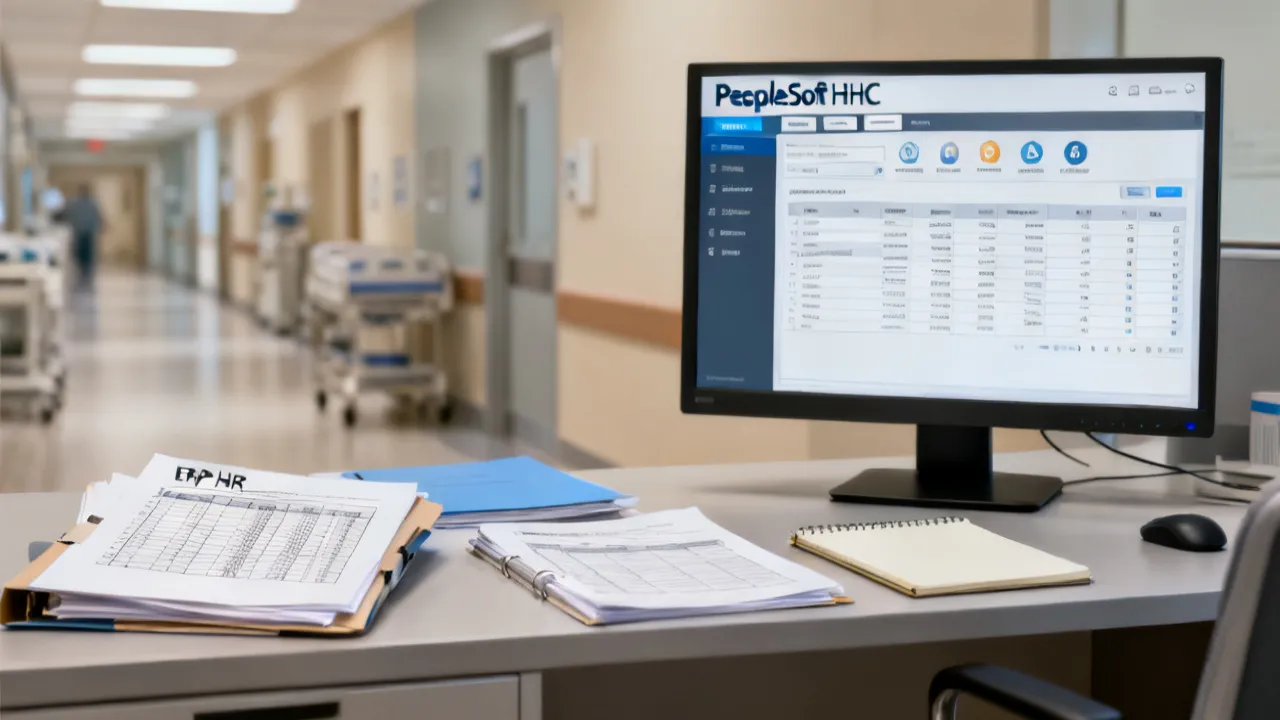
PeopleSoft HHC is often used by healthcare organizations to coordinate people-centered processes and operational records—helping HR and workforce functions align with day-to-day service delivery. In practice, PeopleSoft HHC can reduce manual handoffs between staffing, scheduling, and reporting by providing a structured system of record. For decision-makers, the value is less about a “single module” and more about how governance, data standards, and workflow design come together to produce dependable operational reporting and compliant HR administration.
In many healthcare environments, the people workforce is the operational engine. Every policy—credentialing timelines, staffing coverage targets, labor rules, overtime controls, training requirements, and audit obligations—ultimately touches human resources data. Without a reliable enterprise workflow and an accountable data model, healthcare leaders are forced into manual reconciliation, ad-hoc spreadsheets, or unclear “source-of-truth” definitions. PeopleSoft HHC aims to bring coherence to these realities by centralizing workforce records, standardizing approval paths, and enabling consistent reporting logic across time.
However, the reason PeopleSoft HHC matters is not only technical. It is administrative. It is about how organizations manage change: how a role is approved, how a position is created, how a transfer is authorized, how an exception is handled, and how evidence is produced when compliance requires proof. A healthcare organization may have detailed policies on paper, but those policies only become enforceable when the system workflow, security model, and audit trail are aligned. PeopleSoft HHC is frequently used because it can be adapted to support those policy-driven administrative processes without sacrificing maintainability.
When governance is done properly, PeopleSoft HHC reduces operational friction by making workforce actions traceable. When governance is missing, even a technically functioning PeopleSoft deployment can still fail operationally—because users cannot trust report definitions, approvals become inconsistent, or access controls become too broad. That is why PeopleSoft HHC should be treated as an operating model, not merely a software platform. In the best implementations, healthcare administrators can answer critical questions quickly: “Which staffing decisions were approved?”, “Which policy version governed this change?”, “Which organizational hierarchy was used for this report?”, and “Who validated the data before leadership reviewed it?”
Background: What “PeopleSoft HHC” Typically Refers To
The phrase “PeopleSoft HHC” generally describes a healthcare-focused configuration or deployment pattern built around Oracle’s PeopleSoft platform (including HR and related enterprise capabilities) adapted for healthcare environment requirements. While implementations can vary substantially, the underlying goal is commonly to support workforce and administrative operations in settings where labor rules, reporting timelines, and audit expectations are stringent.
In healthcare, workforce systems are not only about tracking employees. They frequently interact with credentialing cycles, role-based approvals, position management, time and attendance workflows, and reporting that stakeholders use for staffing plans, service coverage, and compliance needs. As a result, PeopleSoft HHC is top evaluated as an ecosystem: master data, access controls, workflow configuration, and reporting design all influence performance.
Although different organizations use different terminology, “HHC” in this context is often shorthand for a healthcare administration-focused HR and workforce solution. In practice, that may include:
- Workforce planning inputs that rely on accurate organizational hierarchies and positions.
- Role-based approval flows that reflect who can authorize changes to employment status, job roles, or internal transfers.
- Time-related processes that connect employee records to attendance reporting and labor compliance requirements.
- Reporting outputs intended for executive dashboards, compliance evidence, and operational readiness tracking.
- Interface touchpoints with ancillary systems such as identity management, scheduling systems, and learning or credentialing platforms.
It’s also common that healthcare organizations expect PeopleSoft HHC to function in environments where staffing churn is high and data changes are frequent. That means the system must support controlled transitions between employment statuses, consistent data validation, and auditability. It must also handle the operational reality of “exceptions”—for example, when a credentialing delay or a staffing shortage requires a temporary role adjustment. PeopleSoft HHC implementations typically aim to make those exceptions visible, governed, and auditable rather than hiding them in manual workarounds.
Finally, PeopleSoft HHC initiatives frequently emphasize interoperability. Healthcare administration is rarely isolated: payroll may be handled elsewhere, scheduling may be a specialized tool, identity management might be centralized, and compliance may require specific evidence records. PeopleSoft HHC therefore must be designed with integration patterns and data mapping strategies from the outset—not as an afterthought.
Industry Expert View: Key Decision Points Before Implementation
An industry expert perspective emphasizes that “success” in a PeopleSoft HHC initiative is usually determined early by choices around:
- Workforce model clarity: defining positions, labor categories, organizational hierarchies, and how roles map to approval paths.
- Master data governance: establishing naming conventions and ownership for personnel, department/organizational structures, and reference tables.
- Security and audit readiness: implementing role-based access, separation of duties, and audit logging practices aligned with internal controls.
- Process design alignment: documenting how requests, changes, and approvals flow through the organization (not just how the screen looks).
- Reporting strategy: confirming what leadership needs, at what cadence, and from which authoritative data sources.
To elaborate on these decision points in a healthcare context, it helps to understand what breaks down when they are handled late. For example, workforce model clarity is often underestimated. If position hierarchies and job-role mappings are not defined early, the organization may later discover that approvals are inconsistent or that reports cannot properly segment labor data by department, service line, or unit. Similarly, if master data governance is unclear—who owns the employee record, which team controls org hierarchy changes, and what rules govern reference data—then the system may function but outputs will not be trustworthy.
Security and audit readiness are also frequently underestimated because they can seem “non-functional” compared to user interfaces. Yet healthcare compliance often depends on evidence: who performed which action, when it happened, and with what authorization. Separation of duties is especially important in processes that impact labor reporting, employment status, credentialed role assignments, or any data used for compliance metrics. If security design is delayed, retrofitting audit controls can be time-consuming and can lead to gaps discovered only after go-live.
Process design alignment means the workflow must represent real approvals and real responsibility. In many healthcare organizations, the administrative flow includes handoffs between HR operations, department managers, compliance teams, and sometimes credentialing authorities. A PeopleSoft HHC workflow must therefore define:
- What triggers a workflow (request type, eligibility, effective date range, etc.).
- Who receives tasks and who can approve, reject, or request more information.
- What data elements are required for approval and what checks should happen before workflow completes.
- How exceptions are handled: what happens when a required attribute is missing, or when a temporary override is granted.
- How the workflow results impact downstream systems and reports.
Lastly, reporting strategy must be grounded in the definitions leadership expects. Healthcare leaders do not simply want “data.” They want consistent metrics. If definitions are ambiguous—what counts as active employment, how “assignment” is defined, or which hierarchy level drives a report—then people stop trusting the system. Reporting strategy is therefore closely tied to data governance and workflow design.
Implementation Economics: What Organizations Should Expect
Organizations frequently ask about “price information” when evaluating PeopleSoft HHC. However, PeopleSoft deployments are highly scoped: costs often depend on the number of entities, interfaces to other systems, data conversion complexity, customization extent, testing cycle size, and the level of training and support needed. Because specific pricing varies by contract and scope, it is more reliable to treat “price” as a negotiation input that should be validated through vendor and partner proposals.
From a procurement standpoint, the very actionable approach is to request a cost model that separates:
- Project management and delivery (discovery, build, testing, cutover)
- Data conversion and integration work (including interface maintenance)
- Licensing and environment costs (where applicable)
- Training, change management, and hypercare support
- Post go-live enhancements and ongoing operations
This separation helps stakeholders compare supplier proposals fairly and reduces the risk of “hidden scope” later in the schedule.
Additionally, healthcare organizations should consider total cost of ownership (TCO) rather than focusing only on initial project spend. Even if two suppliers provide similar headline numbers, the long-term burden can differ significantly based on how much customization is introduced and how maintainable the reporting logic is after go-live. A PeopleSoft HHC deployment with minimal customization can often be upgraded with less disruption, whereas a deployment with extensive customizations can increase future regression testing and upgrade effort.
Another economic factor is operational labor. When PeopleSoft HHC is deployed with strong governance, many manual reconciliation efforts decrease. But if governance is weak, the operational burden can persist even after go-live—because users may still need to validate data, correct issues, or work around inconsistent reporting definitions. Therefore, ROI should consider not only project costs but also reductions in time spent on manual administration and audit preparation.
Healthcare organizations should also budget for “people-process change,” not just technology changes. Training, communications, role-based enablement, and adoption support are often what determine whether the organization realizes the intended value. Many projects underestimate the time needed for managers and HR specialists to adapt to workflow-driven approvals and structured reporting. The cost of training may appear modest compared to project build time, but the impact on adoption and operational effectiveness can be substantial.
Supplier Considerations: Choosing the Right Delivery Team
When selecting a supplier for PeopleSoft HHC implementation, the key is not only technical PeopleSoft capability, but also healthcare operational experience—particularly around governance, workforce administration workflows, and compliance-oriented reporting. The strongest teams typically demonstrate:
- Proven healthcare references: familiarity with workforce and administrative constraints common to healthcare organizations.
- Integration design maturity: experience connecting HR systems with other operational platforms (scheduling, reporting, identity management).
- Test and cutover discipline: structured plans for regression testing, interface validation, and controlled migration.
- Change management capability: adoption-focused training and documentation strategies.
Because implementations vary by organization, you should evaluate supplier responsiveness to your specific workflow documentation, not just product familiarity.
In practice, healthcare administrators can assess delivery teams by asking scenario-based questions. For example: “If a credentialing record arrives late and affects a role assignment, how does the workflow handle it?” Another scenario: “If a department hierarchy changes mid-quarter, how do reports and effective-date rules behave?” Suppliers with healthcare experience are more likely to anticipate those edge cases and propose governance mechanisms—rather than leaving the organization to define the processes under pressure during testing.
It is also useful to evaluate how the supplier approaches requirements traceability and evidence. Healthcare organizations often need to show that configuration aligns with internal controls. Strong suppliers provide documentation that supports audit readiness: mapping of requirements to configuration, test evidence, and sign-offs. When a supplier cannot explain how they ensure traceability from requirement to configuration to testing, healthcare organizations should treat that as a risk.
Finally, consider the supplier’s approach to long-term support. PeopleSoft HHC is rarely “set and forget.” The system must be supported for integration monitoring, security updates, and enhancements. Therefore, a supplier’s ability to deliver a stable runbook, a clear hypercare plan, and a predictable release approach for enhancements is often more important than how quickly they can implement the initial configuration.
Operational Governance for PeopleSoft HHC
Governance is where many deployments succeed or struggle. PeopleSoft HHC environments typically require ongoing control over:
- Data ownership: deciding who maintains master data, who approves changes, and how exceptions are handled.
- Configuration change management: ensuring that enhancements follow a predictable approval and testing cycle.
- Access control reviews: periodic verification of role permissions to maintain compliance and reduce risk.
- Report validation: confirming definitions for key metrics and ensuring users trust the outputs.
In healthcare settings, governance procedures often need to match operational realities—such as staffing cycles, credentialing windows, and leadership reporting calendars—so that system changes do not disrupt care delivery timelines.
To make governance tangible, healthcare organizations often implement a governance structure that includes process owners, data stewards, security administrators, and reporting stewards. A process owner is accountable for workflow behavior and operational outcomes. A data steward is accountable for data definitions and data quality. A security administrator is responsible for role design and access provisioning. A reporting steward is accountable for metric definitions and report consistency. Together, these roles ensure that the system remains aligned with healthcare policies over time.
Configuration change management is especially important because PeopleSoft deployments can evolve. Healthcare policies change—sometimes due to regulatory updates, internal audit findings, or operational restructuring. If configuration changes are made without structured approvals and testing, the organization can inadvertently create “control drift,” where the system no longer behaves as intended. Governance should require that enhancements follow a repeatable lifecycle: intake, impact assessment, requirements approval, configuration build, testing, security review, release planning, and post-release monitoring.
Access control reviews must also be scheduled and evidence-based. Healthcare organizations often see frequent personnel changes—HR staff, managers, compliance roles, and system administrators. Role permission sprawl can occur when exceptions are granted without revocation or when people accumulate permissions after organizational changes. Governance should therefore enforce periodic access reviews using role-based access control (RBAC) principles and should ensure separation of duties where needed.
Report validation is a common governance gap. Many projects validate the technical correctness of reports but do not establish a governance process for report definitions. A healthcare organization may later discover that a report metric used for staffing decisions is calculated differently than leadership expects, or that report logic changes after an upgrade. Report stewardship should include version control for report definitions and a change control process for metric changes. It should also include reconciliation checks with authoritative data sources.
Integration and Data Quality: The Hidden Backbone
Even when the PeopleSoft HHC configuration is technically sound, poor data quality can undermine reporting and operational workflows. Industry top practice stresses that data conversion and ongoing data validation should be treated as continuous work, not a one-time migration effort.
Organizations should plan for:
- Identity matching: handling name changes, employment status transitions, and duplicate records.
- Reference table stability: maintaining consistent definitions for departments, roles, and organizational levels.
- Interface reconciliation: validating that inbound and outbound transactions stay consistent with authoritative sources.
- Exception handling: documenting how anomalies are resolved and who signs off.
Integration in healthcare is not merely a technical concern; it is an operational reliability concern. A scheduling system might need accurate staffing status dates to prevent overbooking or undercoverage. A compliance reporting tool might require timely credentialing information to ensure roles align with required qualifications. If PeopleSoft HHC integration fails or produces inconsistent data, operational teams can be forced into manual adjustments—precisely what the implementation aims to reduce.
Data quality challenges often surface in the areas of identity matching and effective dates. For example, employee identifiers might change during acquisitions or re-organizations. Names might change due to HR processes or administrative corrections. Organizational departments might be restructured, affecting how historical transactions map to current hierarchies. A strong PeopleSoft HHC approach must support effective dating and ensure that reporting logic can handle historical accuracy, not only current state.
Reference table stability is another key theme. Healthcare organizations often have complex structures: labor categories, job codes, role mappings, and organizational levels. If these reference definitions are changed without governance, downstream workflows can break or produce inconsistent approvals. Therefore, reference tables should have controlled update processes, including required approvals and testing impacts.
Exception handling is where trust is built. No system is perfect, especially in complex administrative environments. PeopleSoft HHC should therefore be configured so that exceptions are not hidden. Instead, exceptions should be clearly categorized, logged, and routed to the right owner for resolution. Additionally, the organization should define what happens when exceptions are not resolved within a defined period—whether the workflow waits, continues with warnings, or escalates to leadership.
Finally, ongoing data validation should be operationalized. This can include scheduled data quality checks, interface monitoring dashboards, and periodic reconciliations. Data validation should also include feedback loops: if a data mapping error is detected, the organization should adjust conversion logic or interface rules so that the same error does not recur.
Comparison Table: How to Evaluate PeopleSoft HHC Approaches
Below is a practical comparison of common implementation approaches. This is meant to help procurement and governance teams align on trade-offs rather than prescribe one “top” option for every organization.
| Evaluation Lens | Approach A: Standardized Configuration | Approach B: Targeted Enhancements | Approach C: Heavier Customization |
|---|---|---|---|
| Time-to-value | Often faster if workflows fit standard patterns | Moderate timeline; enhancements address priority gaps | Longer due to deeper build/testing cycles |
| Maintainability | Typically easier to upgrade and govern | Manageable with disciplined documentation | Higher effort for ongoing regression and upgrades |
| Audit and control alignment | More predictable control behavior | Can be strong if requirements are tightly scoped | Requires careful design to avoid control drift |
| Data quality requirements | Still critical; usually aligns with standard structures | Critical; enhancements may require additional validations | Critical; customization may add more data dependency points |
| Total cost of ownership (TCO) view | Often favorable over multi-year horizons | Balanced TCO if enhancements are limited | Potentially higher TCO due to ongoing customization upkeep |
| Fit with healthcare workflows | Top when current processes can be adapted | Top when specific gaps must be closed without redesigning everything | Chosen when unique workflows cannot be standardized |
To evaluate these approaches in a healthcare context, decision-makers should connect the trade-offs to operational risk. For instance, standardized configuration might reduce time-to-value and lower upgrade risks, but it may require process adaptation. Targeted enhancements can close specific gaps while limiting long-term complexity, but they require strict scope governance to prevent “enhancement sprawl.” Heavier customization can address unique requirements, but it increases the risk of regression and can make audit evidence more complex if custom logic affects report calculations or workflow approvals.
Healthcare stakeholders can also evaluate these approaches by asking how each would handle effective dating, exception processing, and audit logging. A good question is: “If we need to show evidence for an audit, which parts of the solution produce traceable outputs?” Standardized configurations typically produce more predictable audit trails, while customized logic must be designed with traceability and test evidence in mind from the beginning.
Another useful evaluation lens is how each approach impacts data stewardship. Standardized configuration often aligns with predictable data model structures and can make it easier to define authoritative data domains. Targeted enhancements can still be governed, but they might introduce additional data validation needs. Heavy customization frequently introduces additional data dependencies, increasing the workload for data stewardship teams and making it easier for small mapping differences to ripple across reports.
Source and Grounding (Objective Reference Points)
For organizations evaluating enterprise HR systems in healthcare contexts, it is useful to align expectations with widely accepted guidance on data governance and software lifecycle management from recognized industry bodies. A common baseline set of practices is outlined in materials from:
- Oracle PeopleSoft documentation: official configuration and administrative guidance (useful for understanding standard capabilities and operational responsibilities).
- NIST (National Institute of Standards and Technology): generally referenced for security and data governance frameworks.
- Healthcare compliance and privacy frameworks: used to shape audit readiness, access controls, and data-handling practices according to local regulations and institutional policy.
When planning PeopleSoft HHC initiatives, align your security controls, audit logging expectations, and privacy practices with applicable laws and internal compliance requirements in your operating environment.
Because healthcare compliance requirements can vary by region and organizational type, healthcare organizations should avoid treating any single framework as a universal answer. Instead, use objective guidance as a foundation and validate it against internal policies, regulator expectations, and risk assessments. The best deployments treat security and governance as part of the solution design rather than a set of end-stage activities.
In practice, NIST guidance can influence how organizations think about risk, access controls, auditing, and configuration management. Meanwhile, Oracle PeopleSoft documentation often provides the authoritative view of what the platform can support and how standard administrative features behave. Healthcare privacy and compliance frameworks then shape how data is accessed, stored, and audited. Together, these reference points can help healthcare organizations create a PeopleSoft HHC design that is defensible in audits and operationally sustainable.
Step-by-Step Guide: A Practical PeopleSoft HHC Implementation Path
This step-by-step outline is designed to be realistic for healthcare administration programs. It assumes you are implementing (or significantly upgrading) a PeopleSoft HHC environment and need controlled adoption rather than a purely technical rollout.
1) Discovery and workflow mapping
Start by mapping real processes end-to-end: intake of HR requests, approvals, workforce status changes, and reporting requirements. Document where decisions are made and who owns each step. Confirm what “success” means for HR leadership and operational stakeholders.
In healthcare, workflow mapping should not stop at “happy path.” Include scenarios such as:
- Emergency staffing adjustments that require fast approvals.
- Credentialing delays affecting role assignment or work authorization.
- Organizational changes such as department restructuring or service-line redesign.
- Employee transfers that affect reporting hierarchies or cost centers.
- Policy exceptions and temporary overrides with time-limited authorizations.
Discovery should also identify current system pain points. If staff spend significant time reconciling report outputs with spreadsheets, the process map should capture that manual activity. That information helps you define target-state workflows and helps justify governance and reporting investments.
2) Define authoritative data domains
Decide what data is authoritative for each domain (e.g., employee identity, organizational hierarchy, positions, job roles). Establish ownership and validation rules. Create data dictionaries that clarify definitions used in reports and workflows.
When defining authoritative data domains, healthcare organizations should consider the difference between “system of record” and “system of engagement.” For example, PeopleSoft may be the system of record for employee identity and positions, while other systems may manage credentialing details. In such cases, you must define how PeopleSoft receives updates and which fields it should treat as authoritative.
Data dictionaries should include:
- Field-level definitions and permissible values.
- Effective date rules and how historical records should be handled.
- Validation logic expectations (e.g., required fields for approval).
- Mapping rules between inbound and outbound interface fields.
- Ownership and escalation pathways for data issues.
3) Security model and audit design
Design roles and permissions based on least privilege. Include separation of duties where needed and define how audit trails will be reviewed. Plan for access review cycles and documented exception handling.
Security design in healthcare HR is not only about who can click what. It is about controlling who can create or modify workforce actions that influence compliance reporting. Common practices include:
- Limiting HR operations rights to required functions only.
- Restricting approval roles so that request creation and approvals remain separated.
- Ensuring managers have access only to the relevant scope (e.g., their reporting units).
- Separating duties for master data changes and configuration changes.
- Designing audit logging for workflow approvals and key field changes.
Audit design should also specify how audit evidence is retrieved. Healthcare audit readiness is often about being able to produce evidence quickly and accurately. Define which reports or audit logs provide the needed proof and how frequently the organization should review them.
4) Configure core PeopleSoft HHC capabilities
Implement standardized functionality where possible before introducing enhancements. Configure workflows, organizational structures, reference tables, and approvals. Validate each configuration against the documented workflow map.
This phase is where organizations should resist “configuration drift.” It is common for teams to make incremental changes during build, which can accumulate into a configuration that no longer matches the initial requirements. Governance can help by requiring configuration documentation and approvals at each stage.
During configuration, it is also valuable to define “minimum viable controls.” Instead of trying to replicate every possible policy nuance at once, define the core controls that must be enforced for operational safety and compliance. Then iterate for additional enhancements in later phases.
5) Plan integrations and interfaces
Identify systems that provide inputs to PeopleSoft HHC and those that consume outputs. Develop interface requirements, message formats, error handling rules, and reconciliation methods. Conduct interface testing early—not only near cutover.
Healthcare integration often includes both technical and operational considerations. For example, interface delays can create downstream staffing reporting gaps. You should therefore define:
- Interface SLAs: how quickly data should be transmitted and updated.
- Error handling: what happens when a record fails to map or validate.
- Reconciliation: how you detect and correct mismatches between systems.
- Monitoring: alerts for interface failures, data quality anomalies, and unusual transaction volumes.
- Fallback strategies: what teams should do if the integration is temporarily unavailable.
Interface testing should also include edge cases such as name changes, organizational moves, and partial data. If your interface design does not handle these, you risk discovering the problems only during cutover when operational impact is highest.
6) Data conversion and validation
Perform staged data conversion, followed by validation checks that confirm referential integrity, correct mapping of organizational structures, and consistent status transitions. Include manual review workflows for exceptions.
Data conversion in healthcare is rarely a simple “load and go.” It must preserve historical accuracy where needed. For example, leadership reporting might require analysis by time periods, cost centers, and reporting hierarchies. Your conversion strategy should therefore define:
- Which historical records need to be converted for reporting continuity.
- How effective dating should be handled during conversion.
- How to map legacy organizational structures to the new hierarchy.
- How to handle duplicates and identity mismatches.
- How to manage “unknown” or missing reference data.
Validation should be repeatable and evidence-based. Consider building a validation playbook that includes expected record counts, referential integrity checks, exception reports, and sign-off mechanisms for data corrections.
7) Testing: unit, system, and operational readiness
Use a layered testing strategy:
- Unit-level testing: confirm configured transactions behave as expected.
- System testing: verify end-to-end flows including approvals and reporting output.
- Operational readiness testing: ensure support teams can manage cutover, rollback considerations, and hypercare procedures.
For PeopleSoft HHC, testing should emphasize workflow approvals, effective dating, audit evidence capture, and reporting accuracy. Because healthcare operations depend on reliable outputs, it is not enough to test that the transaction completes successfully. Testing should also verify that the resulting data supports the intended operational reporting use cases.
Operational readiness testing is particularly important in healthcare. Support teams must be able to respond to real-time issues during cutover and hypercare. Therefore, runbook rehearsals, incident categorization, and escalation pathways should be tested with realistic scenarios.
8) Training and change management
Train users on role-specific workflows and reporting interpretation, not only on navigation. Provide job aids that reflect the exact terms and approval steps used in your healthcare environment. Plan communication for HR teams, managers, and operational stakeholders.
Because healthcare roles are diverse, a one-size training approach often fails. Instead, training should be role-based and outcome-based. For example:
- HR specialists need deep training on workflow steps, required data fields, exception resolution, and audit logging implications.
- Managers need clarity on their approval responsibilities, the scope of their access, and what happens when an approval is rejected or returned.
- Operational leaders may need training on interpreting staffing and labor reports, including understanding what the metric definitions mean operationally.
- Compliance-focused users may require training on evidence retrieval and audit support processes.
Change management should also include communications that explain why PeopleSoft HHC is changing operational processes. Staff adoption is higher when users understand the operational benefits—like reduced manual handoffs and improved report trust—rather than viewing the system as a purely technical upgrade.
9) Cutover and hypercare
Execute a controlled cutover plan with clear responsibilities. Hypercare should monitor transaction completion, interface errors, and user friction points. Track issues by severity and resolution pathway, and establish a decision cadence for urgent corrections.
Healthcare cutover planning should include operational continuity. If a staffing reporting process relies on specific data refresh cycles, then you must plan for transitional periods. Cutover planning also should include rollback considerations and data reconciliation steps so that if issues occur, the organization can recover quickly and with minimal disruption.
Hypercare should include dashboards or reports that show key operational indicators. For example, monitor:
- Workflow task completion rates and turnaround times.
- Interface error counts and failure reasons.
- Data validation exceptions and their resolution status.
- User support tickets by category.
- Report generation success and report accuracy checks.
It can also be helpful to establish an “urgent change” decision process with clear guardrails. During hypercare, the pressure to patch issues can be high. A disciplined change process reduces the risk that emergency fixes introduce new control problems.
10) Post go-live stabilization and continuous improvement
After stabilization, run a structured review cycle to assess whether processes match expectations. Use metrics that reflect operational outcomes (e.g., cycle times for approvals, accuracy of reports, reduction in manual reconciliation effort). Ensure enhancements follow governance and testing standards.
Continuous improvement should not only focus on feature requests. It should evaluate the system’s operational effectiveness. For instance, if approval cycle times remain long, the problem may not be the system—it could be workflow design, missing required data, or insufficient training. The improvement process should therefore include root cause analysis and the involvement of process owners.
Organizations may also implement periodic “report accuracy” audits after go-live. These can compare system-generated results to authoritative sources to confirm that report metrics remain aligned. Over time, governance processes should also evolve based on lessons learned.
Conditions and Requirements for Sustainable Adoption
For PeopleSoft HHC initiatives, the following conditions commonly determine whether the program remains sustainable beyond initial launch:
- Clear ownership: appoint process owners for HR workflows and master data domains.
- Documented governance: maintain change control processes for configuration and reporting definitions.
- Interface accountability: define monitoring responsibilities for each integration point.
- Training tailored to roles: ensure managers and HR specialists receive training aligned to their responsibilities.
- Security reviews: conduct periodic access reviews and update roles when organizational structures change.
- Report stewardship: assign accountability for metric definitions and report validation.
Sustainable adoption also depends on feedback loops. When users discover issues—incorrect data mapping, unclear workflows, or ambiguous reporting logic—they should know where to report problems and how those problems are triaged. Without feedback loops, organizations can end up with informal workarounds that bypass the system controls.
Another requirement is operational maturity. PeopleSoft HHC deployments often require process discipline: consistent request formatting, timely approvals, and defined exception handling. If teams revert to informal behaviors, the system’s structured advantages diminish. Therefore, adoption plans should include behavior expectations and monitoring.
Risk Management: Common Pitfalls to Avoid
Even well-funded PeopleSoft HHC programs can face avoidable risks. Typical pitfalls include:
- Underestimating integration complexity: interface errors and reconciliation gaps can appear late if not tested early.
- Ambiguous role permissions: incomplete security design may cause operational delays or compliance concerns.
- Weak data governance: inconsistent master data can degrade report trust and increase manual corrections.
- Customization sprawl: excessive enhancements can increase regression risks and reduce upgrade flexibility.
- Insufficient operational readiness: support teams need practical cutover/runbook guidance, not only system walkthroughs.
To make risk management more practical, healthcare organizations can use a risk register that assigns clear owners and mitigations. Risks should be prioritized by operational impact. For PeopleSoft HHC, risks often concentrate in the areas of effective dating, workflow approvals, and interface reconciliation. Effective dating issues can produce misleading reports. Workflow approval issues can create compliance gaps. Interface reconciliation issues can produce labor status mismatches that affect staffing decisions.
Another frequent pitfall is failing to involve operational stakeholders early. If workflow mapping focuses only on HR administrators and excludes department managers, compliance teams, and operational leaders, the system may not reflect real approval needs. The result is often workflow rework after testing begins—an expensive and disruptive outcome. Early stakeholder engagement can prevent that.
Finally, risk can arise when reporting requirements are treated as a “later phase.” Healthcare leaders often base staffing decisions and operational coverage planning on workforce reports. If report definitions are not confirmed early, the organization may discover contradictions between report expectations and system logic. These contradictions can persist until go-live, undermining trust and adoption.
FAQs About PeopleSoft HHC
Q1: What is PeopleSoft HHC used for?
PeopleSoft HHC is commonly used to support healthcare-focused administrative operations—especially workforce and HR-related processes—through a structured enterprise platform that can be configured to match healthcare workflow requirements.
Beyond basic HR recordkeeping, PeopleSoft HHC deployments often enable structured workflows for workforce changes, approval evidence for compliance, and consistent reporting outputs that leadership uses for staffing and operational oversight.
Q2: How do I estimate the price for a PeopleSoft HHC project?
Because pricing depends on scope, request a cost model that breaks out project delivery, data conversion, integration work, training, and ongoing support. Compare proposals by scope clarity and assumptions, not by headline figures alone.
When comparing proposals, ask suppliers to specify assumptions explicitly—for example, how many integrations are included, how much data conversion is required, what environments are provided, and how many training sessions or training materials are included. This helps you evaluate total scope and avoids surprises later.
Q3: What should I look for in a supplier offering PeopleSoft HHC services?
Evaluate supplier experience in enterprise HR delivery and healthcare operational workflows, along with their test discipline, integration approach, and change management maturity. Ask for examples of similar implementations and how they handled governance and audit readiness.
Strong suppliers should also be able to describe how they manage requirements traceability, test evidence documentation, and cutover planning. In healthcare, those aspects can be as important as build speed because they determine operational reliability and audit defensibility.
Q4: Is customization always necessary for healthcare environments?
Not necessarily. Many organizations start with standardized configuration to reduce upgrade and maintenance burden. Targeted enhancements are considered when specific workflow gaps cannot be resolved through standard patterns.
A key question to ask is whether your organization can adapt processes to fit standardized controls. If not, targeted enhancements may be appropriate—but customization should be justified with clear operational outcomes and governance plans to ensure it remains maintainable.
Q5: What are the very common implementation timelines drivers?
Workflow mapping complexity, data conversion effort, interface dependencies, testing breadth, and cutover planning are common drivers. Programs also extend when security roles, reporting validation, or integration reconciliation are not fully specified early.
Healthcare organizations should treat these drivers as scope-related. Timelines often stretch when requirements are discovered late, when data quality issues appear during conversion, or when report definitions require significant rework. Early discovery and strong governance reduce timeline risk.
Q6: How can we ensure reporting is trustworthy after go-live?
Implement report stewardship: validate metric definitions, reconcile outputs with authoritative sources, and establish change control for reporting logic. Train users on how to interpret and use key reports for decision-making.
Trust is not only about accuracy—it is also about consistency over time. If reporting logic changes without governance, leadership may lose confidence. Therefore, report stewardship should include version control and a defined process for updating reporting logic.
Q7: What governance controls should be prioritized?
Prioritize master data ownership, controlled configuration changes, role-based access reviews, audit trail monitoring, and a structured process for handling exceptions and data anomalies.
In healthcare, audit trails matter because evidence must be retrievable. Governance should therefore define what actions are audited, how those logs are stored, and who reviews them. Additionally, exception processes should have documented decision pathways so that operational actions remain consistent.
Q8: Does PeopleSoft HHC require continuous support after deployment?
Yes. Healthcare organizations typically need ongoing operational support, enhancement governance, interface monitoring, security updates, and periodic training refreshers as roles and processes evolve.
Continuous support also includes monitoring system performance and data quality. When interface errors occur, quick detection and resolution prevent downstream reporting issues and operational disruptions.
Conclusion: Treat PeopleSoft HHC as an Operating Model, Not Only Software
PeopleSoft HHC initiatives succeed when teams view the platform as part of an operating model: workforce governance, data quality management, secure access controls, and reporting stewardship must work together. By selecting a delivery approach that balances standardization with targeted enhancements, and by executing a disciplined implementation plan with clear supplier accountability, organizations can build a PeopleSoft HHC environment that supports reliable healthcare administration and good adaptability.
Ultimately, the most effective PeopleSoft HHC deployments are those where healthcare administrators can rely on the system for both day-to-day operational decisions and long-term compliance evidence. When governance is active and when data definitions are stable, PeopleSoft HHC becomes a dependable backbone for HR administration and workforce reporting. When governance is weak and reporting definitions remain unclear, the same platform can become a source of operational friction. The difference is not merely configuration—it is the operating model built around it.
For healthcare organizations planning or improving PeopleSoft HHC, the best path forward is to prioritize clarity: clarity in workflow ownership, clarity in authoritative data definitions, clarity in security responsibilities, and clarity in reporting metrics. With that clarity, PeopleSoft HHC can deliver tangible improvements—reducing manual handoffs, increasing audit readiness, improving reporting trust, and enabling more responsive staffing administration in environments where accuracy and accountability matter every day.