Receivables Explained with Investopedia Insights and Risk Controls
This guide explains receivables fundamentals and how to manage them with evidence-based controls aligned with Investopedia-style definitions. It provides objective background on what “receivables” means in accounting, why aging matters, and how businesses assess credit exposure, collect payments, and protect cash flow without assumptions.
Receivables: a practical framework for managing credit risk and cash flow
Receivables are amounts customers owe your business for goods or services delivered, and they often represent a major portion of working capital. When organizations manage receivables with a disciplined process—clear credit policies, an aging review, and a consistent collections rhythm—they improve cash predictability while controlling credit losses. This article uses the concept of Receivables Investopedia-style accounting clarity to build a professional, risk-aware approach that you can apply regardless of industry.
In plain terms, receivables sit between “revenue recognized” and “cash received.” The gap is where timing risk, credit risk, and operational risk can emerge. A well-designed system reduces uncertainty by answering practical questions: Who owes, how long they have owed, how likely they are to pay, and what action is appropriate.
Although the phrase Receivables Investopedia is often used as a shorthand for authoritative definitions and neutral explanations, the operational challenge is the same everywhere: receivables are only valuable if they ultimately convert into cash (or are otherwise settled) in a reliable timeframe.
Many companies treat receivables management as a back-office activity—something to “handle” after invoices are issued. In practice, the highest-performing organizations treat receivables as a system that begins at order entry and ends at cash application. That system includes credit decisions, accurate invoicing, dispute prevention, and a collections workflow that respects both customer relationships and risk thresholds.
This matters because receivables can quietly become a drag on performance even when sales growth looks healthy. A company can appear successful in profit terms while simultaneously becoming liquidity-constrained due to slower collections. By contrast, companies that manage receivables proactively often experience smoother cash cycles, fewer surprises, and improved resilience during economic stress.
What receivables represent in financial reporting
From an accounting perspective, receivables generally appear as current assets when expected to be collected within a normal operating cycle. They are commonly associated with trade accounts receivable, notes receivable, and other short-term obligations owed to the company. The core idea is consistent: receivables quantify your claim against customers, not cash in hand.
Because customers can delay payment—or default—financial statements typically incorporate mechanisms for credit risk. A common one is the allowance for doubtful accounts (often paired with an aging-based or probability-informed estimate). The purpose is not to “guess” in an arbitrary way; it is to match expected losses to revenue periods using defensible methods.
In practice, companies must reconcile three perspectives:
- Legal claim: what your contract entitles you to collect.
- Accounting presentation: what your accounting framework requires you to recognize and how you present expected credit losses.
- Operational reality: what your customer service, billing accuracy, dispute handling, and collections processes can actually achieve.
When those perspectives align, receivables become a credible and auditable asset. When they do not, receivables can become “financial fiction”—balances that exist in reports but fail to convert into cash at the pace management expects.
Why an aging schedule is central to receivables risk
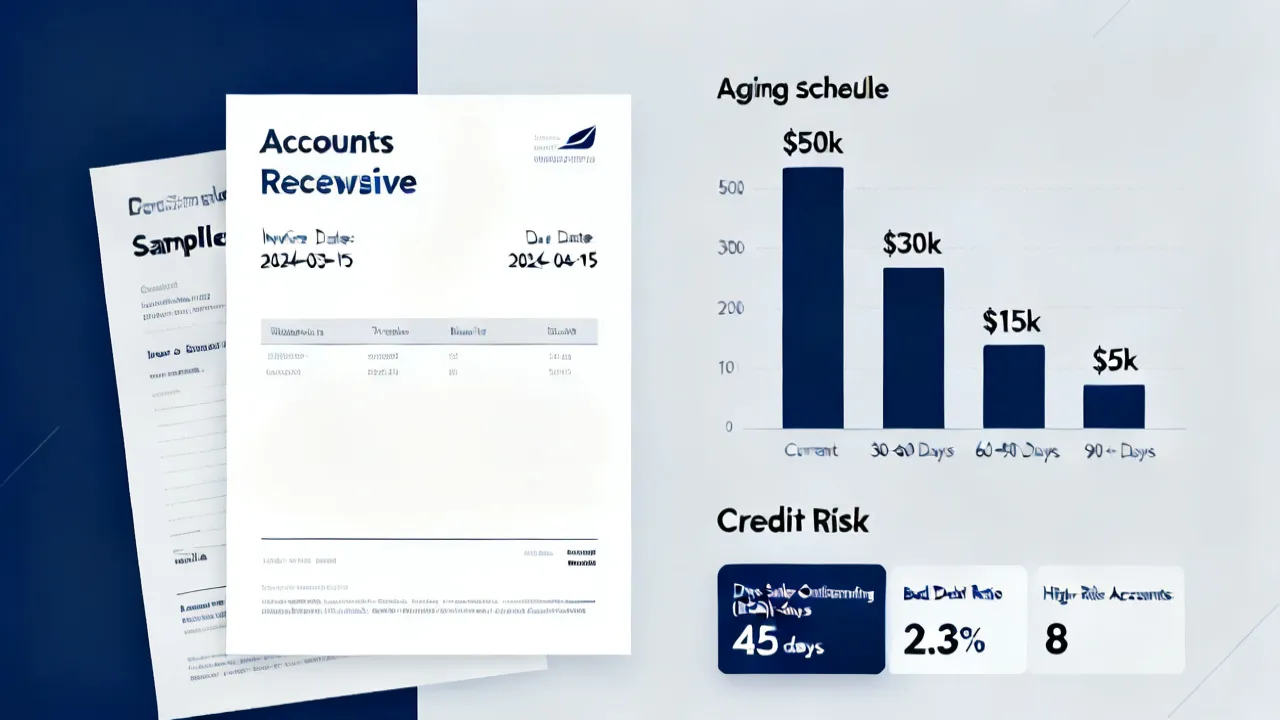
An aging schedule groups receivables by how long an invoice has been outstanding, such as “current,” “1–30 days,” “31–60 days,” “61–90 days,” and “over 90 days.” This segmentation matters because the probability of collection generally declines as invoices age. The aging view helps management prioritize actions and prevents staff from treating all receivables as equally collectible.
Aging also makes performance visible. Without aging, a company might only see total receivables. With aging, management can see whether collections are improving in the early buckets but deteriorating in later buckets, or whether the whole distribution is shifting unfavorably.
For objective governance, many organizations combine aging with transaction history (e.g., disputes, deductions, prior payment patterns) and current credit standing. The operational goal is to convert receivables management from an end-of-month “cleanup” into a continuous risk process.
It’s useful to understand that aging is not only a collections tool; it is a diagnostic tool. When aging changes suddenly, it often signals upstream problems such as billing defects, changes in fulfillment practices, contract disputes, or credit policy changes.
For example, if invoices move from “current” into “1–30 days” faster than usual after a pricing update, that may indicate invoice issuance delays or misapplied payment terms. If invoices jump directly to “over 90 days,” that may indicate severe disputes, customer insolvency, or a breakdown in escalation.
Credit exposure: balancing sales growth with collectability
A key tension in receivables management is growth vs. risk. A company can increase sales, but if it relaxes credit terms or approves customers without adequate assessment, receivables can grow faster than collection capacity. That growth can temporarily boost reported revenue while increasing the likelihood of write-offs or cash strain.
Credit exposure is influenced by several factors:
- Customer credit quality: financial strength, payment behavior, and stability of operations.
- Terms and timing: due dates, early-payment discounts, and escalation rules.
- Invoice quality: accurate billing details, correct references, and timely delivery documentation.
- Dispute management: the faster discrepancies are resolved, the less cash is delayed by friction.
In a structured receivables program, these factors are reflected in policies, workflow ownership, and measurable outcomes (e.g., days sales outstanding, dispute cycle time, and bad debt rate).
However, credit exposure is not always obvious from credit limits alone. Exposure can concentrate in ways that a credit analyst might not immediately see: for example, through off-book agreements, unbilled work-in-progress disputes, or credit notes that are slow to issue. Some companies also unintentionally extend credit through operational delays—promises made to customers that do not match contract terms.
To manage this effectively, organizations should treat credit exposure as a dynamic variable. It changes with billing accuracy, contract compliance, fulfillment timing, and customer communication quality. A mature system therefore combines credit policy with operational monitoring.
Supplier and counterparty dynamics: where “suppliers” fit into the receivables story
The request mentions supplier details, and it’s important to clarify roles objectively. Suppliers are often discussed on the payables side (what your company owes), while receivables focus on what customers owe. However, supplier-related considerations can still influence receivables indirectly:
- Revenue delivery reliability: if upstream suppliers delay inputs, invoices may be delayed, disputed, or partially billed—affecting receivables quality.
- Contract alignment: mismatches between supplier timelines and customer commitments can create chargebacks or deductions.
- Operational evidence: if proof of delivery or service completion is tied to supplier records, invoice disputes can increase when documentation is incomplete.
Put differently: suppliers do not “create receivables,” but supplier performance can affect how smoothly receivables convert into cash.
To make this practical, consider a service business that depends on subcontractors. If subcontractor work is late or lacks proper documentation, the service firm might be unable to invoice correctly. That can lead to “underbilling” (which means fewer receivables) but also to later invoice revisions or disputes (which means those receivables may become harder to collect).
Even though suppliers are not the direct counterpart in receivables, operational dependencies matter. A comprehensive cash cycle view includes both receivables and payables, because the business’s liquidity depends on the combined timing of customer payments and supplier payments.
Cash flow impact and the “working capital reality”
Receivables are not just a balance sheet line; they influence liquidity. When collections slow, cash may become insufficient to fund payroll, inventory replenishment, or required obligations. Many finance teams monitor working capital indicators to detect early stress—particularly when receivables growth outpaces revenue growth or when aging trends upward.
For objective benchmarking, it’s safer to track internal trends and corroborate them with publicly available industry research from reputable sources such as:
- U.S. Federal Reserve releases and surveys related to credit conditions and business finances
- Industry reports from recognized accounting and credit management organizations
- Peer-reviewed or methodologically transparent publications
This article avoids speculative or unverifiable numeric claims. Instead, it focuses on controls and decision logic that remain valid across business models.
A helpful way to conceptualize receivables in liquidity terms is to look at the “cash conversion cycle” and related measures. Even without heavy mathematical complexity, you can ask: How much cash is tied up in receivables today compared with last quarter, and what is changing—collections speed, invoice volume, or dispute behavior?
When receivables rise faster than operating cash flow, the gap can come from:
- Higher sales on extended credit terms
- Billing delays or errors
- Increased disputes and deductions
- Customer credit deterioration
- Concentration risk (a few large customers slowing payments)
Tracking these drivers allows finance leaders to distinguish between “good growth” that is still cash-efficient and “growth with hidden cost.”
Risk controls: what industry experts emphasize in receivables management
Industry practitioners often converge on several themes when designing receivables governance. Below is an expert-oriented, practical set of controls you can adapt.
1) Standardize invoice creation and validation
Receivables quality starts at billing. Controls commonly include invoice templates, mandatory fields, and automated checks (e.g., order number, service period, pricing references). The goal is to reduce errors that later become customer disputes—disputes that delay payment even when the underlying obligation is valid.
Standardization is not only about formatting. It is about completeness and traceability. A disciplined invoice should allow the customer to validate quickly. If the customer cannot easily match an invoice to a purchase order or contract, the invoice is more likely to get stuck in internal approval workflows or get contested.
Invoice validation controls often include:
- Reference integrity: order numbers, contract IDs, and billing periods.
- Pricing compliance: ensure prices match agreed schedules, not manual overrides.
- Tax and fee accuracy: correct tax treatment and proper fee inclusion.
- Document completeness: attach proof of delivery, timesheets, or service completion evidence when applicable.
- Workflow rules: prevent “final” invoices from being sent without required approvals.
From a risk perspective, the highest ROI action is often to eliminate repeat billing defects. If the same issue causes disputes month after month, it likely indicates a process weakness that will drain cash through delayed payments.
2) Define credit terms and approval thresholds
Credit terms should reflect customer risk. Many organizations implement credit approval workflows with tiered limits. If a customer exceeds an internal risk threshold, the company may require a shorter payment term, a deposit, or additional documentation.
Credit approval thresholds are most effective when they are structured as a decision tree rather than a vague policy statement. For instance:
- For low-risk customers with stable payment history, extend standard terms.
- For mid-risk customers, keep standard terms but require periodic credit reviews or limit increases only after consistent payment.
- For high-risk customers, require deposits, partial prepayments, or tightened terms (e.g., “net 15” instead of “net 60”).
Additionally, credit policy should clarify what happens when limits are breached. Some organizations allow orders to proceed but then manage the increased risk later in collections; others halt further sales when limits are exceeded. The best choice depends on business strategy, concentration risk, and customer relationship priorities, but the key is that the decision must be intentional and consistent.
Credit approvals should also be periodically revisited. A customer’s risk profile changes due to macroeconomic conditions, operational issues, or changes in ownership. A periodic review process ensures that credit decisions do not become outdated.
Finally, credit policy must coordinate with sales. Sales teams need to understand the “why” behind credit decisions. When credit is perceived as arbitrary, customers may get frustrated, but when credit decisions are framed as predictable rules and time-bound reviews, cooperation tends to improve.
3) Use an allowance approach grounded in evidence
Accounting standards support recognition of expected credit losses using reasonable and supportable data. While specific models differ by jurisdiction and accounting framework, experts emphasize consistent methodology and audit-ready documentation. Aging schedules, historical loss rates by cohort, and forward-looking considerations (when permitted and supportable) are typical inputs.
From a practical perspective, the allowance process should not be treated solely as a year-end accounting exercise. It is more useful when it feeds operational decisions:
- Which customers or segments contribute most to expected losses?
- Are write-offs aligning with the patterns predicted by the allowance model?
- Are there late-payment clusters that indicate a policy gap?
When the allowance model consistently overestimates or underestimates losses, it can create distortions. Overestimation can suppress profitability and cash planning. Underestimation can delay recognition of credit issues and increase surprises in financial statements.
Therefore, allowance methodology should include governance over model updates. If you revise assumptions, you should document why, how, and what evidence supports the change. This protects credibility with auditors and internal risk committees.
Also consider how “dispute” interacts with allowance estimates. Disputes do not always equal credit losses, but persistent disputes can be a leading indicator of credit trouble or operational breakdown. A thoughtful process distinguishes between:
- Amounts that are disputed but likely collectible after resolution
- Amounts that are disputed because the customer cannot pay (or is unwilling to pay)
- Amounts that become non-collectible due to insolvency or contract failure
This distinction helps ensure the allowance does not conflate operational friction with true credit risk.
4) Build a collections workflow with escalation rules
Collections should be proactive, not reactive. A common expert pattern is to define actions by invoice age—such as reminder emails, calls, account reconciliation, escalation to senior collections, and eventual legal referral when appropriate.
Crucially, escalation rules must be coordinated with dispute handling so legitimate issues are resolved quickly rather than endlessly re-queued.
A well-designed collections workflow typically includes:
- Customer communication cadence: reminder frequency and channels (email, phone, portal access, statements).
- Owner assignment: every invoice must have an identifiable collections owner or team.
- Dispute tagging: a clear indicator that an invoice is disputed vs. undisputed.
- Escalation triggers: based on aging, amount thresholds, or absence of response.
- Legal readiness: standard documentation for legal escalation and compliance requirements.
Escalation policies should also consider customer relationships. For some industries (e.g., enterprise procurement environments), too aggressive collections language can harm long-term contracts. The best teams use escalation as a structured escalation ladder—firm, respectful, and consistent.
Additionally, collections workflow should support resolution. Many receivables fail to convert to cash not because customers refuse to pay, but because they cannot reconcile the invoice quickly. In those cases, a collections agent who can quickly coordinate with billing or customer service can reduce friction and accelerate payment.
5) Monitor KPIs tied to customer behavior
Effective teams track more than a single metric. Relevant KPIs often include:
- Days Sales Outstanding (DSO): average time to collect receivables
- Dispute rate and dispute cycle time: how often invoices are contested and how long disputes last
- Current vs. past-due mix: early warning indicator of deteriorating collection health
- Cash conversion effectiveness: how receivables move toward cash over time
For definitions and neutral context, readers frequently cross-reference Receivables Investopedia explanations alongside professional accounting resources. The important point is to apply metrics consistently, not to chase one “top” number.
To make KPIs operationally useful, they should be broken down by dimension:
- Segment (industry, geography, contract type)
- Customer size (top customers vs. long tail)
- Invoice type (products vs. services, one-time vs. recurring)
- Dispute reason codes
This breakdown helps identify where improvements are most needed.
For example, a stable overall DSO might conceal a deterioration in one segment that is offset by better performance elsewhere. Without segmentation, management may miss emerging risk.
Receivables in practice: common scenarios and how controls help
To ground the discussion, consider a few objective scenarios.
Scenario A: Invoices age upward after a customer merger. The company may be right to expect consolidation issues or new approval layers. The company should not automatically label this as credit deterioration. An aging review combined with customer contact history helps differentiate temporary friction from a structural credit deterioration. A good practice is to create a “temporary hold” classification only if there is documented evidence, and to re-evaluate quickly after the merger integration phase.
Scenario B: High dispute volume increases days to cash. Instead of focusing only on chasing overdue invoices, an expert team links disputes to root causes: billing errors, missing delivery documentation, or unclear contractual terms. Fixing upstream causes typically lowers both disputes and bad debt. In addition to process fixes, improving dispute reason codes and resolution SLAs provides clear accountability and helps quantify improvements over time.
Scenario C: Sudden increase in write-offs in one segment. That pattern can indicate a credit policy gap, a concentration risk, or a contract problem. Experts respond by tightening approvals for that segment and reviewing contract terms, while reassessing the allowance method with evidence. The response should include examining whether the write-offs correspond to the aging cohorts predicted earlier. If write-offs are much higher than expected, it may indicate that the allowance model is not capturing a new risk environment.
Scenario D: Concentration risk—one large customer slows payment. In many businesses, a few accounts represent a large portion of receivables. If one large customer delays payment, overall DSO might worsen quickly. A mature receivables program uses concentration limits, enhanced monitoring for top accounts, and early communication workflows. It may also involve setting aside additional credit protections such as tighter payment terms, progress billing, or collateral where appropriate and legally permitted.
Scenario E: Recurring invoicing fails due to service documentation issues. In subscription or services models, invoices may be generated automatically. However, if service confirmation evidence is missing—such as timesheets, usage logs, or acceptance certificates—customers may contest invoices. The solution is not necessarily a collections push; it can be an integration improvement between service delivery systems and invoicing. When operational evidence is automated and consistent, dispute rates typically drop.
These scenarios illustrate that receivables problems are rarely purely “collections problems.” They are usually process problems, credit problems, or evidence problems that surface as payment delays.
Methodological comparison: approaches businesses use (and when they apply)
| Approach | How it works | Top used for | Conditions / requirements |
|---|---|---|---|
| Aging-based prioritization | Sort receivables by days outstanding and act by age bucket | Operational collections workflow | Accurate invoice dates; consistent aging logic; dispute tagging to avoid misclassification |
| Credit tiering and limits | Assign credit limits and terms based on customer risk tier | Preventing excessive exposure | Documented approval rules; periodic credit reviews; monitoring of limit breaches |
| Allowance for doubtful accounts | Estimate expected credit losses using supportable data and defensible methodology | Financial statement integrity | Audit-ready assumptions; consistent historical data; governance over model updates |
| Invoice quality and validation controls | Reduce billing errors through standardized templates and checks | Reducing disputes and payment delays | ERP/invoicing governance; clear ownership of billing corrections |
| Customer dispute workflow | Track disputes, evidence, and resolution timelines | Minimizing “stuck” receivables | Dispute reason codes; reconciliation steps; SLA for resolution |
In practice, the strongest programs do not rely on one approach. They use a “stack” of controls that reinforce each other. Aging helps prioritize. Credit tiering prevents excessive risk. Allowance methods improve financial transparency. Invoice quality reduces disputes. Dispute workflows reduce stuck invoices.
When implementing these approaches, it is often better to ensure data accuracy and workflow discipline first, before trying to adopt complex analytics. Many organizations can improve cash outcomes substantially just by tightening billing and dispute handling, even before sophisticated credit models are introduced.
Sources and reliable references (for neutral definitions and credit context)
For background definitions and accounting context, the following types of authoritative sources are commonly used:
- Accounting standards bodies for guidance on impairment/allowance concepts (jurisdiction-dependent).
- Central bank and regulator publications for credit conditions and business finance context.
- Credit risk and collections professional organizations for operational top practices and KPI interpretation.
When teams cite Receivables Investopedia terminology, it is typically as a definition anchor. For decision-making and measurement, experts supplement definitions with their applicable accounting guidance and internal audit requirements.
Because accounting rules vary by jurisdiction and reporting framework, companies should ensure their receivables impairment and allowance methodology aligns with their local requirements and their external auditor’s expectations. If you operate across multiple regions, you may need a harmonization approach that preserves compliance while maintaining operational consistency.
Step-by-step guide to improving receivables performance
Below is a practical improvement sequence that many finance leaders adopt. The emphasis is on measurable controls and governance.
Step 1: Create a receivables baseline
Calculate DSO, review aging distribution, and quantify disputed and past-due volumes. Use consistent time periods so trends are comparable. If you already have aging reports, verify that dates, customer classifications, and dispute tags are accurate.
A baseline is not only numerical. It should include process baseline information such as:
- How many days elapse between invoice creation and customer receipt
- How many invoices are corrected after issuance
- Average dispute cycle time by reason code
- Collections staffing ratios or coverage by customer segment
- Any recurring root causes observed in customer calls
These additional baseline elements are often the difference between superficial improvements and durable change.
Step 2: Diagnose root causes by segment
Segment receivables by customer, invoice type, and dispute category. Then ask: Is the issue timing, billing accuracy, credit policy, or dispute resolution speed? Expert teams avoid treating the problem as one-size-fits-all.
Root cause analysis works best when you adopt a structured approach:
- Compare actual vs. expected behavior: where does it deviate from normal?
- Identify leading indicators: what changes first—disputes, billing rework, or aging?
- Look for process breaks: new team members, system changes, contract updates, or supplier delays.
- Assess concentration: are a few accounts driving the majority of deterioration?
If you find that a small number of customers represent most of the late-stage aging, you can focus remediation on credit decisions and customer-specific workflows rather than applying broad, inefficient tactics.
Step 3: Tighten invoice readiness controls
Implement required fields, validation rules, and a clear process for corrections. Reduce preventable rework before invoices are issued. Many organizations discover that small billing defects drive disproportionate collection friction.
Invoice readiness controls can be expanded beyond basic validation. For example:
- Approval gates: ensure contracts, pricing, and service evidence are approved before billing.
- Reconciliation checks: verify invoice totals match order quantities or service units.
- Automated document attachment: attach proof of delivery, acceptance certificates, or service logs when required.
- Controlled change management: if billing logic changes, require testing and monitoring for the next few billing cycles.
These controls require effort, but they typically deliver cash outcomes quickly because fewer invoices are disputed and fewer payment cycles are delayed by clarification.
Step 4: Review credit approval thresholds and monitoring
Ensure credit approvals reflect customer risk. Refresh credit checks periodically and define what triggers re-review (e.g., limit breaches, sustained past-due aging, or changes in payment patterns).
Credit monitoring can be designed as a tiered system:
- Baseline monitoring: periodic credit checks and limit reviews.
- Event-based monitoring: re-check upon major contract changes, corporate restructuring, or customer-level payment anomalies.
- Behavioral monitoring: track changes in payment speed, dispute frequency, or unusual deductions.
When credit is monitored based on behavior, you often detect issues earlier than when relying solely on periodic financial statements. Payment behavior can reflect distress before formal insolvency indicators become obvious.
Also consider how you treat disputed amounts within credit monitoring. If a customer is disputing frequently, even if not always due to non-payment, the overall risk profile may increase because it indicates either operational friction or potential unwillingness to pay.
Step 5: Implement an escalation-based collections workflow
Create a timeline of actions by aging bucket. Ensure collectors coordinate with billing and disputes teams. Define escalation paths and document the rationale for legal or recovery actions.
Escalation workflows typically require clear roles and SLAs. For example:
- Collectors handle initial contact and gather customer context.
- Billing analysts correct invoice issues and provide supporting documentation.
- Dispute coordinators resolve disputes using evidence and reason codes.
- Credit managers review exposure for high-risk customers.
If those roles are unclear, escalation becomes chaotic and the customer perceives inconsistency. The result can be slower resolutions and increased friction.
Additionally, collections should be supported by robust data. A collector should be able to see:
- Invoice history (including corrections or credit notes)
- Past payment patterns
- Dispute status and resolution history
- Contact history and recent communications
In modern implementations, these data are integrated into a single customer receivables view. Even if you do not have a sophisticated system, you can create “receivables snapshots” to reduce information gaps.
Step 6: Reassess the allowance methodology and documentation
Review whether the allowance approach aligns with the actual loss experience and aging behavior. Confirm assumptions are supportable and documented for audit purposes.
Reassessment should include a “back-testing” mindset: do the allowances predicted for certain aging cohorts match actual outcomes? If not, the methodology may require refinement. Common causes of mismatch include:
- Incomplete historical data (missing customer-level outcomes)
- Changing business model (new product lines, new contract terms)
- Process changes (new dispute handling workflow or invoicing automation)
- Economic shocks (customer credit deterioration not captured in assumptions)
When adjustments are made, document both the evidence and the reasoning. The allowance process is not merely accounting compliance; it is a risk representation that should reflect reality as closely as possible.
Step 7: Track KPIs and run continuous improvement cycles
Establish recurring reviews (weekly operational; monthly financial). Improvements should be evaluated through reduced dispute cycle time, improved aging distribution, and stabilized cash conversion.
Continuous improvement also means learning from customer behavior. If certain customers consistently dispute invoices for valid technical reasons, you may need customer-specific documentation procedures. If certain reason codes recur, you may need systematic improvements to billing or contract interpretation.
A useful practice is to run structured monthly “receivables performance reviews” that cover:
- Top aging movements and root causes
- Write-off and recovery performance
- Dispute trends and resolution performance
- Credit limit breaches and policy outcomes
- Process improvement initiatives and their measured effects
These reviews should culminate in action items with owners and deadlines. Without ownership, improvement becomes a discussion rather than a program.
Conditions and requirements for a defensible receivables program
- Process documentation: collectors, billing, and credit teams should have clear playbooks.
- System integrity: ERP and reporting must accurately reflect invoice dates, due dates, and dispute status.
- Segregation of duties: credit approvals and allowance estimates should follow governance controls.
- Audit-ready evidence: assumptions for loss estimates and actions taken should be traceable.
- Consistent policy application: exceptions should be documented and reviewed to prevent bias or operational drift.
To make these requirements practical, consider the “minimum viable governance” that many organizations implement first:
- A formal credit policy approved by finance and sales leadership
- Standard credit application workflow with documented evidence requirements
- Invoice approval checklist to ensure invoice completeness before sending
- Dispute workflow with reason codes and an SLA for resolution
- Collections escalation matrix tied to aging and dispute status
- Monthly allowance and credit monitoring reviews
As maturity increases, companies often expand with automated credit checks, integrated dispute portals, and more advanced analytics. But governance fundamentals are what keep the system consistent and reliable.
Frequently Asked Questions (FAQs)
What are receivables in accounting?
Receivables are amounts due from customers or other parties for goods or services delivered, recorded as assets to the extent collection is expected. They represent a contractual claim, not cash already received.
How does receivables management affect cash flow?
Effective management accelerates collections and reduces delays caused by disputes or credit issues. When receivables convert into cash more reliably, the company can fund operations with less liquidity strain.
What is an aging schedule and why is it important?
An aging schedule groups invoices by how long they are outstanding. Because collection likelihood typically decreases as invoices age, aging helps prioritize follow-up and supports more accurate credit risk monitoring.
Does receivables management include supplier information?
Directly, receivables relate to customers who owe money. However, supplier performance can indirectly affect receivables through delivery reliability, documentation, and the quality of invoicing evidence used to support claims.
How do companies estimate bad debt or expected credit losses?
Companies typically use evidence-based methods such as historical loss patterns by aging cohort and, where permitted, forward-looking information that is supportable and consistently applied. The approach must be documented to satisfy audit and governance requirements.
What KPIs should a receivables team track?
Common KPIs include DSO, past-due ratio, dispute rate, dispute cycle time, collections effectiveness by aging bucket, and the allowance coverage ratio (where applicable). Use internal trend analysis and consistent definitions.
What if customer disputes are driving very delays?
Experts typically respond by tightening invoice validation, improving documentation, and implementing an SLA-based dispute workflow with clear reason codes and escalation paths. Reducing billing friction often improves days-to-cash more than chasing overdue invoices alone.
How can a company balance credit risk and revenue growth?
Use credit tiering and approval thresholds, monitor exposure, and adjust terms when risk changes. The goal is to maintain sales while ensuring that collectability remains within an acceptable risk framework.
Final takeaway: treat receivables as a risk-managed asset
Receivables are central to business liquidity, and the definition-level clarity associated with Receivables Investopedia is only the starting point. The value comes from disciplined controls: standardized billing, credible credit decisions, aging-based prioritization, evidence-based allowance processes, and a collections workflow that resolves disputes quickly. When those elements work together, receivables become a predictable engine for cash conversion rather than a lingering uncertainty on the balance sheet.
To make that outcome durable, the key is to build a system with feedback loops. Billing controls reduce disputes; dispute resolution speed improves cash conversion; collections discipline prevents risk from compounding; credit monitoring updates exposure; allowance methodology reflects evidence; KPI dashboards reveal early warning signals. In that integrated system, receivables management stops being a reactive function and becomes a continuous risk management capability.