Understanding Libf Degrees and Credential Pathways
This guide explains what “Libf Degrees” typically refers to, how credential pathways are structured, and what learners should verify before committing time or budget. It provides an objective overview of how liberal-arts–oriented credentials can function across institutions, emphasizing accreditation checks, progression criteria, and outcomes-focused decision-making for prospective students.
Key Takeaways on Libf Degrees
“Libf Degrees” is commonly used as an umbrella phrase for a type of credential pathway that leans toward liberal-arts foundations (and, in some contexts, broader professional readiness). Because the exact meaning can vary by institution, the very important step is verification: confirm the awarding body, the qualification level, the curriculum scope, and—critically—its recognition status in your target region and industry. If you are comparing options, prioritize accredited delivery, transparent assessment rules, and documented progression routes over marketing claims.
In practice, “Libf Degrees” often signals that you’ll be studying for outcomes typically valued across many sectors: writing and documentation, critical analysis, research literacy, and reasoned ethical thinking. But the same term may be used loosely by different providers. That’s why you should treat the phrase as a signpost, not as proof of quality or recognition.
To evaluate effectively, you’ll want to align four things: (1) what the qualification is called officially, (2) who awards it and under what standards, (3) what evidence of learning you will produce, and (4) how that evidence will be interpreted by employers or universities in your next step (job applications, graduate admissions, licensing, or professional registration).
What “Libf Degrees” Usually Means in Practice
In many education markets, “Libf Degrees” is shorthand learners use for programs that emphasize transferable skills—critical thinking, written communication, research literacy, ethical reasoning, and domain context. These credentials may be offered as stand-alone degrees, structured “bridging” awards, or components within a wider study plan (for example, moving from foundational learning toward a specialized final qualification).
However, the term itself is not universally standardized. That means your interpretation should be evidence-based: ask for the official qualification title as printed by the awarding institution, the qualification framework level (where applicable), and the precise course structure. If you want comparability, request a program specification document rather than relying on summaries or promotional pages.
When providers say “liberal-arts foundation,” they often mean you’ll spend significant learning time on themes such as:
- Textual and analytical study (e.g., reading, interpretation, argument evaluation)
- Structured writing (academic essays, reports, reflective practice)
- Research methods (source selection, citation practices, basic methodology)
- Quantitative or logical reasoning when needed for analysis and evidence evaluation
- Ethics and social context (frameworks for responsible decision-making)
- Humanities or social-science perspective that helps you contextualize issues and communicate with diverse audiences
But the proportion and depth of each area differs substantially by program type and level. Some “Libf Degrees” are closer to a full liberal-arts degree; others are a stepping stone designed to prepare you to enter a more specialized professional degree or industry certification.
Why Credential Pathways Matter for Outcomes
When prospective learners search for “Libf Degrees,” they’re usually trying to answer a practical question: “Will this credential improve my options?” Industry-recognized outcomes often depend less on the label and more on the mechanism behind the credential—such as:
- Accreditation and recognition: Is the awarding body recognized in the jurisdiction where you plan to work or continue education?
- Assessment rigor: Are learning outcomes evaluated through exams, project work, or verified competence standards?
- Progression design: If the credential is part of a pathway, are there clear entry and exit points?
- Curriculum relevance: Do modules build toward measurable competencies rather than only theoretical coverage?
Credential pathways matter because employers and universities interpret your readiness based on evidence. Evidence can be in the form of grade transcripts, portfolio artifacts, capstone projects, dissertation summaries, and standardized examinations. A good liberal-arts–oriented pathway should make that evidence easy to understand and compare.
Another practical point: pathways often affect your time-to-competence. Even if the credential is academically valid, your outcome depends on whether the program teaches you how to demonstrate competence in ways that are recognized. For example, a program that emphasizes essay-based analysis may produce strong evidence for roles involving policy writing, research support, communications strategy, or education contexts. A program that emphasizes applied projects and documented methods may align better with roles requiring practical deliverables or client-style problem solving.
Therefore, your goal is to choose the “Libf Degree” pathway that best fits your intended next step. That could be:
- Employment (entry-level roles or career pivot roles where transferable skills are valued)
- Further study (admission into a specialized bachelor’s, master’s, or advanced diploma)
- Professional registration or licensing (where rules may depend on specific qualifications or mandated credit content)
How to Evaluate Libf Degree Options Objectively
From an industry-leaning perspective, the “top” Libf Degrees option is the one that aligns your learning plan with how employers or graduate programs evaluate evidence of capability. Here’s the evaluation approach many experienced advisers use:
1) Confirm the Official Qualification Title and Level
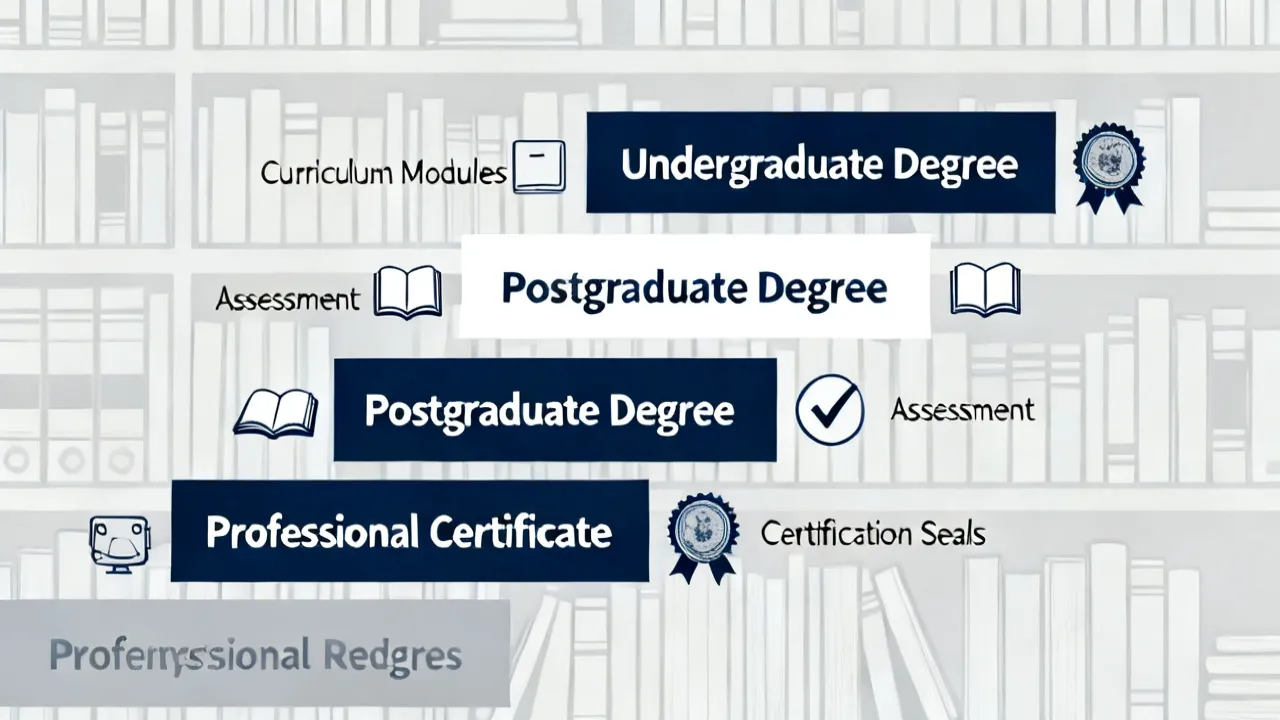
Never assume the market term matches the official document wording. Request the official qualification title (and the level, such as undergraduate degree level or another framework level where applicable). This is also where you confirm whether the credential is a full degree versus a pathway component.
When you review the official title, also check whether it includes clarifying wording such as “with honors,” “foundation,” “bridge,” “top-up,” “integrated,” “applied,” or “specialization.” These words can strongly affect how admissions teams interpret your outcomes.
Additionally, confirm what “level” means in that system. Some regions use national qualification frameworks with assigned levels (for example, Level 4, Level 5, Level 6). Others may use degree categories like “bachelor,” “master,” or “diploma.” The key is that level should be traceable to an established framework so that recognition is not subjective.
2) Verify Accreditation and Recognition
Recognition is often the difference between a credential that’s academically accepted and one that functions smoothly in professional settings. If you are comparing multiple suppliers, check:
- Which authority accredits the program (if accreditation is offered/required in your region).
- Whether the qualification is recognized for employment or professional registration (where relevant).
- Whether recognition is consistent across borders, especially if you might relocate.
For any claims about recognition, look for documentation from official frameworks or regulators. When in doubt, ask the institution to provide written evidence.
It’s also worth understanding how recognition is typically verified. Some institutions are recognized automatically by virtue of being chartered or established under national education law. Others require accreditation renewal. In some cases, the qualification may be recognized at a general level (e.g., “a degree”), but specific content requirements may be needed for certain jobs or further education. So you should confirm recognition both “as a credential” and “as a pathway entry tool” for your specific target.
Practical question to ask: “If I apply to [graduate program/professional body/employer category], what recognition status do you typically see for graduates of this qualification?” A credible provider should be able to talk about recognized outcomes honestly and can usually cite examples (without overclaiming).
3) Assess the Curriculum Structure and Skill Coverage
Libf Degree pathways typically aim to cultivate transferable skills, but the depth varies. Compare module lists and learning outcomes in detail. A strong design shows progression—how early modules build research and writing foundations, how intermediate units develop analysis and applied reasoning, and how final assessments demonstrate integrated competence.
To evaluate curriculum structure, look for evidence of scaffolding. Good programs typically include:
- Foundational modules where you learn academic conventions (referencing style, argument structure, basic research literacy)
- Method modules where you practice how to gather and evaluate evidence (qualitative and/or quantitative methods as appropriate)
- Integrative modules where knowledge from different areas is combined into a final product
- Capstone or dissertation-level work (where relevant) that demonstrates independent competence
Also check whether the curriculum includes the skills you’ll be tested on. Sometimes programs are advertised as “writing heavy,” but the assessments may be more exam-based or less rigorous than expected. Conversely, some programs may include a lot of reading and writing in learning materials but fewer opportunities to demonstrate those skills directly in assessed work. Your evaluation should be assessment-led.
If your goal is career readiness, you should also look for modules that reflect real professional communication: structured reports, stakeholder-style writing, evidence-based recommendations, and reflective ethics or case analysis.
4) Review Assessment Methods and Academic Support
Assessment transparency matters. Understand whether the program uses:
- Invigilated exams or standardized testing
- Portfolio-based submissions
- Capstone or dissertation-style work
- Group projects with individual accountability
Then consider support: tutoring hours, feedback turnaround expectations, library/research resources, and guidance for dissertation or project milestones. These features often differentiate “adequate” learning from genuinely effective learning.
To evaluate assessment quality, examine:
- Rubrics: Are there clear marking rubrics that describe how grades are awarded?
- Sample work: Do they provide examples of past assessments at different grade levels?
- Feedback cycle: When and how quickly do you receive feedback?
- Academic integrity training: Do they teach referencing and plagiarism prevention before high-stakes assessments?
- Resit/resubmission rules: Are they fair, consistent, and clearly explained?
If a program is largely portfolio-based, you should ask how the program verifies the learner’s authorship and ensures that learning outcomes are actually met. In some cases, portfolio submissions need external moderation or plagiarism detection. In robust programs, there is usually a quality assurance workflow.
5) Consider Timelines, Workload, and Completion Conditions
Prospective learners frequently underestimate workload. Ask for typical study hours per week, pacing recommendations, and the conditions required to pass modules or progress to the next stage. If the program includes bridging components, ensure you understand what happens if you do not meet progression thresholds.
When considering timelines, also check:
- Assessment scheduling (are assessment deadlines fixed? do they shift? how many windows exist?)
- Turnaround time for graded work
- Extension policy: how late submissions are handled and under what circumstances
- Progression requirements for stage transitions
- Credit transfer rules, if you already have prior learning
For learners balancing work and study, the “real” cost is not just money—it’s time, stress, and opportunity cost. A program with unclear progression thresholds can become expensive if you need multiple resits. A program with transparent assessment rules makes it easier to plan.
Industry Perspective: What Employers Usually Look For
Employers generally do not hire based on a keyword phrase like “Libf Degrees.” Instead, they look for evidence of skills and readiness. For liberal-arts–oriented credentials, recruiters often weigh:
- Written communication: the ability to produce clear, structured documentation
- Analytical thinking: reasoned conclusions based on evidence
- Research capability: locating sources, evaluating credibility, and synthesizing information
- Professional conduct: ethical reasoning, reliability, and teamwork behaviors
Therefore, the top way to evaluate a Libf Degree pathway is to examine how it evidences these competencies—through assessments, projects, and how learning outcomes are measured.
In interviews and applications, the details matter. For example, employers may not see “liberal arts” directly, but they may see that you produced:
- a research report with a clearly structured methodology and citations
- a capstone project with documented problem framing and outcomes
- work that demonstrates you can interpret policy or social context responsibly
- writing samples that reflect the ability to communicate to non-specialist audiences
For many roles, your transferable skill evidence is more persuasive than the label. The strongest “Libf Degree” pathways are those that intentionally produce artifacts that translate into real workplace outputs: structured documents, reasoned analyses, and ethically grounded recommendations.
Price, Supplier, and Location Considerations (What to Verify)
Your prompt referenced price information and supplier details, plus location-specific context. In very real selection processes, price differences are strongly influenced by delivery mode, duration, cohort size, and whether additional learning support is included. Because you didn’t provide specific figures or named suppliers, the very responsible approach is to explain the variables you should request and compare directly from each provider.
When you contact suppliers, ask for a written breakdown of:
- Tuition and any registration or administrative fees
- Assessment fees (if applicable)
- Technology or platform access costs (for online delivery)
- Resit or retake policies and any associated costs
- Included learning materials and whether they require separate purchase
Where the term “nearby” is relevant, evaluate how local delivery affects your experience: access to mentoring, the availability of in-person workshops, and the ease of attending examination sessions. If your plan includes studying nearby, also confirm schedule options (evenings/weekends), travel expectations, and local campus facilities.
Location also affects learning access in less obvious ways. For example:
- If exams require in-person attendance, how flexible are exam dates and travel arrangements?
- Do local facilities provide library databases and research support, or do you rely purely on online access?
- Is there access to academic advisers, writing support centers, or tutoring services locally?
For online or hybrid pathways, ask how examinations are supervised and how academic integrity is handled. If there are remote proctoring requirements, check the technical requirements (internet stability, webcam access, lighting conditions, and device compatibility). If the program requires campus visits, ask the frequency and cost implications.
Comparison Table: Pathway Types, Evidence, and Suitability
The table below compares common ways “Libf Degrees” may be structured. Since specific program names and pricing vary by supplier, treat this as a framework for decision-making rather than a substitute for official documentation.
| Pathway/Program Type | What it Often Includes | Evidence to Request | Top Fit When You |
|---|---|---|---|
| Foundation-to-Degree Pathway | Introductory liberal-arts modules leading toward a full degree or advanced stage | Official progression requirements, curriculum map, and completion rules | Want a structured route with clear stage-by-stage expectations |
| Degree Program with Transferable Skills Focus | Core liberal-arts coursework plus applied projects or research components | Assessment rubrics, module learning outcomes, examples of past work expectations | Prefer depth in writing, analysis, and research |
| Work-Integrated or Applied Credential Variant | Projects aligned to industry scenarios; sometimes includes placements or simulations | Details on project supervision, competencies assessed, and quality assurance | Need stronger applied proof of skills |
| Credit-Transfer Friendly Pathway | Designed for learners transferring modules from prior study | Credit transfer policy, recognition criteria, and documented equivalencies | Already hold prior qualifications and want continuity |
Sources and Step-by-Step Guide to Verify Libf Degrees
To keep this process objective, rely on documentation and established quality principles used across higher education. The list below describes a practical verification workflow you can apply to any “Libf Degrees” offering.
Step-by-step guide (recommended verification process):
- Collect official program documents from each supplier: the program specification, qualification title, and module outlines.
- Confirm awarding authority and whether the credential is awarded by an accredited or recognized body in your target jurisdiction.
- Check qualification level and learning outcomes: ensure the learning outcomes match your intended career or further study.
- Review assessment methods and pass/progression requirements, including resit or retake conditions.
- Request a detailed fee schedule: confirm what is included, what is optional, and what triggers additional charges.
- Verify recognition pathways: ask how the credential is treated for admission into advanced degrees or professional pathways (where relevant).
- Evaluate delivery mode: online vs. in-person, frequency of support, and examination arrangements.
- Cross-check quality indicators using reputable external references (e.g., official quality assurance bodies where available).
Conditions and requirements to prepare in advance:
- Minimum entry requirements (academic background, English proficiency where relevant, or equivalent evidence)
- Ability to meet study hours and deadlines (especially for research or portfolio modules)
- Required documentation for enrollment (transcripts, ID, prior credential certificates)
- Academic integrity policies (referencing standards, plagiarism rules, examination conduct)
- Progression rules (what happens if you miss an exam window or fail a module)
Potential sources to consult (general references):
- Official higher education quality assurance frameworks in your country or region (e.g., national accreditation/quality bodies).
- Institutional “program specification” and “student handbook” documents.
- Reputable education research sources discussing graduate outcomes and employability skills (for context on how transferable skills are valued).
Note: because “Libf Degrees” can refer to different credentials across markets, always confirm details directly with the awarding body and use official frameworks for recognition checks.
Deep-Dive Verification: Questions That Reveal the Difference Between “Marketing” and “Mechanics”
Many learners discover too late that two programs with similar marketing language can differ dramatically in mechanics. To prevent this, you can ask targeted questions that force clarity. The goal is to identify whether the program is built on verifiable assessment and recognized quality processes.
Consider asking each provider the following categories of questions during a call or in writing.
Qualification and Awarding
- What is the exact official name of the qualification I will receive?
- Who is the awarding body (the entity that confers the credential)?
- Is the program accredited by a recognized authority in my country/region?
- What qualification framework level is it mapped to (if applicable)?
- Is it a full degree, a pathway component, a top-up, or a bridging award?
Curriculum and Learning Outcomes
- Can you provide the program specification and learning outcomes document?
- How do modules progress from foundations to higher-level skills?
- Which modules explicitly teach writing, research methods, and critical analysis?
- Are there any “non-credit” activities (workshops, seminars, reading groups) that are not reflected in assessment?
- Do you provide a curriculum map showing how learning outcomes are assessed and evidenced?
Assessment Quality and Integrity
- What are the assessment types (exam, portfolio, project, dissertation, reflection)?
- Do you provide assessment rubrics and grading criteria in advance?
- What is the process for academic integrity and plagiarism prevention?
- How do you verify authorship for online or portfolio work?
- What is the typical feedback turnaround time after submission?
Progression, Resits, and Completion
- What are the rules for progression between stages?
- What happens if I fail a module—do I resit, repeat, or re-register?
- Are resits available at predictable times, and what are the costs?
- What are the maximum extension options if work or life events disrupt deadlines?
- What are the “completion conditions” (minimum credits, required capstone, dissertation requirements)?
Recognition for Your Specific Next Step
- How do graduates typically use this qualification for employment?
- For my target job category, do you have documented outcomes or graduate stories?
- If I want graduate study, what admissions pathways accept this credential?
- Do professional bodies recognize it, and are there any subject prerequisites?
- Do you offer guidance for CV building or translating academic evidence into workplace language?
Cost Transparency and Hidden Costs
- Can you provide a full fee schedule including mandatory and optional charges?
- Are there costs for assessments, certification, transcripts, or moderation?
- Are there additional platform subscriptions or technology requirements?
- What is the cost and process for retakes and resubmissions?
- What are the cancellation and refund terms?
Delivery and Student Support
- How is teaching delivered (live sessions, recorded content, tutoring)?
- What is the ratio of instructor support to student cohort size?
- What research resources are available (library databases, e-books, journal access)?
- Is writing support provided (editing guidance limits, writing center services)?
- Are there accommodations policies for accessibility and learning needs?
How to Interpret Outcomes and “Success Stories” Carefully
Providers often share graduate success stories. Those can be useful, but you should interpret them carefully. A success story is a starting point, not a guarantee. The most reliable information usually comes from:
- transparent graduate outcome reports
- documented employment rates (where available)
- institutional quality assurance statements
- third-party recognition assessments
Even when outcomes are positive, learners should check whether the success stories align with their own circumstances. For example:
- If a graduate got a job quickly, what was their prior experience?
- Did they apply to similar roles as you want?
- Were they in a specific location or country where recognition is stronger?
- Was the program delivered full-time or part-time?
Also pay attention to what employers actually value. If employers in your industry emphasize portfolios and writing samples, then a liberal-arts program that provides strong assessed artifacts may be a good fit. If employers emphasize specific technical competence, you may need additional training beyond the liberal-arts foundation.
Common Misconceptions About “Libf Degrees”
Because the phrase “Libf Degrees” is not always standardized, misunderstandings are common. Correcting these misconceptions can prevent wasted time or money.
Misconception 1: The Label Automatically Ensures Accreditation
Some programs are marketed using liberal-arts language, but accreditation and recognition must be verified. The official awarding documents will tell you whether the credential meets recognized standards.
Misconception 2: Transferable Skills Mean “No Hard Assessment”
Transferable skills still require rigorous assessment. A high-quality liberal-arts program will test those skills through structured rubrics, graded writing, research assignments, exams where appropriate, and credible moderation processes.
Misconception 3: All Liberal-Arts Programs Are Equivalent
Even among accredited programs, curricula differ. Some are writing-heavy; others are more research or theory-centered; others incorporate applied projects. Employers and graduate programs may interpret evidence differently depending on what you were assessed on.
Misconception 4: Local Study Automatically Improves Quality
Studying near you might improve convenience and access to support, but quality is driven by awarding standards, assessment integrity, curriculum structure, and recognition status. Always verify those aspects regardless of location.
How to Make Your Own “Evidence Plan” Before You Enroll
A powerful way to evaluate and choose a “Libf Degrees” pathway is to design an evidence plan. Instead of only asking “What credential do I get?”, ask “What evidence will this credential generate, and will that evidence support my next step?”
Start by identifying your target:
- Which job family are you applying to?
- Which graduate programs are you considering?
- Do you need the credential for recognition by a professional body?
- What kind of documents or artifacts do those audiences value?
Then map program assessments to those needs. For example:
- If you want policy or communications work, prioritize programs with evaluated writing, argumentation, and evidence synthesis.
- If you want research assistant roles, look for research methods, citation training, and graded research projects.
- If you want management or ethical leadership roles, look for modules with case analysis and ethically grounded decision-making assessments.
Finally, plan how you will reuse artifacts. Many learners underestimate the value of turning assessed work into CV highlights, portfolio samples, and interview stories. A program that provides robust, clear assessments makes it easier to produce professional-grade evidence you can show to employers.
Practical Checklist Before You Commit
Before enrolling in any program marketed under the “Libf Degrees” umbrella, use this checklist:
- Official title and qualification level confirmed in writing
- Awarding authority identified clearly
- Recognition/accreditation verified via official frameworks or documented institutional evidence
- Assessment and progression rules reviewed, including resit/retake conditions
- Total fees and payment timeline understood (including any optional extras)
- Curriculum outcomes matched to your career plan
- Student support assessed (feedback cadence, tutoring availability, research resources)
Frequently Asked Questions About Libf Degrees
FAQ 1: What exactly are Libf Degrees?
“Libf Degrees” is a term commonly used to describe liberal-arts–oriented degree pathways or qualifications. The exact curriculum scope and official qualification title vary by supplier and region. For certainty, request the official program name, awarding authority, and qualification level from the institution.
FAQ 2: Are Libf Degrees recognized for employment?
Recognition depends on the awarding authority and how employers assess your skills and evidence of competence. Many liberal-arts degrees support employability through transferable skills such as communication and analysis. Always verify recognition status with official sources and review how graduates describe their outcomes in credible channels (and where possible, with verified data).
FAQ 3: How do I compare price fairly between suppliers?
Compare total cost of ownership: tuition, registration/admin fees, assessment costs, resit policies, and included learning resources. Ask each supplier for a line-item fee schedule and ensure you compare the same qualification level and study duration.
FAQ 4: What entry requirements should I expect?
Entry requirements vary. Common requirements can include prior academic qualifications, subject readiness, and—depending on delivery region—language proficiency. Ask for the minimum criteria and any pathway-specific prerequisites (especially for bridging components).
FAQ 5: If I study nearby, does that change the program quality?
Studying near your location can improve convenience and access to support, but it does not automatically guarantee better quality. The quality drivers are accreditation/recognition, assessment standards, curriculum design, and the strength of student support services. Verify these items regardless of delivery location.
FAQ 6: Can I transfer credits into a Libf Degree pathway?
Some programs are credit-transfer friendly. To know for sure, request the supplier’s credit transfer policy, the list of accepted prior qualification types, and the documentation required for evaluation. Also ask how partial credit affects your timeline.
FAQ 7: What should I ask during a consultation call?
Ask about the official qualification title, awarding body, accreditation status, curriculum map, assessment methods, progression and resit conditions, total fee schedule, and recognition outcomes for your intended next step (employment role or advanced degree admission).
FAQ 8: What documents should I ask for before paying a deposit?
Request the program specification, qualification framework mapping (if applicable), module outlines, assessment regulations, student handbook or learner agreement, and a full fee schedule. If the provider cannot share these documents in advance (or shares them only after you pay), that is a signal you should be cautious and ask for clarification.
FAQ 9: Will employers understand a liberal-arts–focused credential?
Often yes—especially when the credential includes clear evidence of skills you can communicate in a CV and interviews. Employers may not care about the label “liberal arts,” but they care about the capacity to analyze, write, research, and apply ethical judgment. You can strengthen this by requesting evaluated artifacts and planning how to present them professionally.
FAQ 10: Are online “Libf Degrees” credible?
Online delivery can be credible if the awarding body and program meet recognized standards and assessments are conducted with integrity. What matters is accreditation/recognition, assessment quality, learning outcomes, and support resources—not whether the classes are online or in person.
Choosing Between Two Similar Options: A Practical Decision Framework
If you are comparing two “Libf Degrees” options that appear similar at first glance, you can use a decision framework that prioritizes verifiable differences. For example:
- Recognition: Which awarding body is recognized in your target region and industry?
- Assessment evidence: Which program produces stronger, clearer artifacts (writing samples, capstone deliverables, research outputs)?
- Progression certainty: Which one has transparent progression requirements and fair resit policies?
- Support: Which offers stronger writing/research support, tutoring, and feedback mechanisms?
- Cost predictability: Which has fewer ambiguous “optional extras” and more transparent retake fees?
This method can prevent you from selecting based purely on promotional language, delivery convenience, or a lower advertised tuition cost that later increases due to hidden fees or additional attempts.
Conclusion: Make Your Choice Evidence-Based
Libf Degrees can represent valuable educational journeys centered on transferable skills and structured academic development. Yet the very important discipline is verification. Treat marketing language as a starting point, then rely on official documents, recognition checks, transparent assessment structures, and clear progression rules. If you compare suppliers using consistent criteria—qualification level, awarding authority, recognized standing, curriculum outcomes, and complete fee schedules—you’ll be in the strongest position to choose a program that genuinely supports your goals.
Ultimately, the “best” Libf Degree option is the one that produces credible, assessable evidence aligned with your next step. When you confirm recognition, understand how learning outcomes are evaluated, and ensure that you can complete the pathway with clarity on deadlines and resits, you turn a potentially confusing market term into a practical, measurable educational decision.